The mountain never leaves anyone indifferent.
Even those who never go there look at it.
Even those who don't know it feel it.
All it takes is a line on the horizon.
A peak outlined against the sky.
And something happens.
A halt,
A silence,
A form of respect.
But why?
Why does the mountain attract us so much, even from a distance?
A presence that transcends the landscape
The mountain is not just a backdrop.
It's not just another landscape.
It imposes a presence.
Unlike the sea, which stretches out,
Unlike the forest, which envelops,
The mountain stands tall.
It creates a rupture.
It forces the gaze to stop.
And in that simple gesture, looking up,
There is already something different.
A question of scale
Facing the mountain, we change dimensions.
Everything becomes relative.
Distances.
Time.
The body.
What seemed big, becomes small.
What seemed important, becomes secondary.
And perhaps that's where the fascination begins:
The mountain puts things back in their place.
Without speaking.
Without explaining.
Just by its presence.
Silence as an experience
There's a particular moment in the mountains.
A moment when noise disappears.
Not completely.
But enough to make way for something else.
The wind.
The breath.
The step.
This silence is not empty,
It is dense.
And it's a silence rarely found elsewhere.
It's this silence that many seek... Without always knowing how to name it.
What the mountain evokes in us
The fascination is not just visual.
It is internal.
The mountain evokes:
- Calm
- Humility
- Sometimes discomfort
- Often a sense of appeasement
It doesn't seek to seduce.
It doesn't seek to please.
And that's precisely why it resonates.
Because it is raw.
Translating the mountain differently
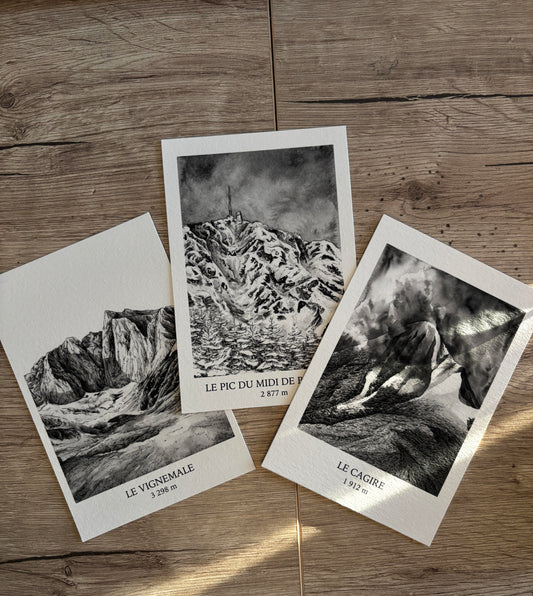
When I draw the mountain, I don't try to reproduce it.
I try to recapture that sensation.
Not the colors.
Not the realistic details.
But:
- The structure
- The tension
- The contrast
That's why black and white is essential.
Because it removes everything that is not essential.
And leaves only what matters.
Black and white: an obvious choice
The mountain doesn't need color to exist.
It exists through its lines.
Through its ridges.
Through its masses.
Through its contrasts.
Black and white allows for:
- Simplification
- Reinforcement
- Clarification
And above all, it allows the gaze to focus.
On the essential.
A universal fascination
What's striking is that the mountain touches very different people.
Some go there often.
Others never.
Some know it.
Others don't.
And yet, the reaction is often the same:
"It's soothing"
"It feels good"
"You can breathe"
As if the mountain spoke a universal language.
Bringing the mountain into your home
We don't all live in the mountains.
But we can keep a trace of it.
A presence.
A breath in an interior space.
A drawing, a work of art, allows precisely that:
To bring a sensation into a place
Not a faithful reproduction.
But an evocation.
A reminder.
A work of art as an anchor point:
In an interior, a mountain artwork doesn't just fill a wall.
It creates a focal point.
A place where the gaze comes to rest.
A space for pause.
In an often fast-paced daily life,
it acts as a discreet slowdown.
What we are truly looking for
Ultimately, the fascination with the mountain may not be related to the mountain itself.
But to what it allows us to feel:
- Calm
- Clarity
- A form of perspective
And perhaps, simply,
A moment where everything stops.
Extending this sensation
If the mountain attracts you,
If it soothes you,
If it speaks to you...
Then perhaps it's no coincidence.
Some works are designed precisely for this:
- To capture this sensation
- And make it present, in daily life
Black and white art prints,
Inspired by peaks
Limited editions